
The Sales Outsourcing Decision Tree


- This sales outsourcing decision tree uses six yes/no questions to show whether outsourcing fits your situation, and which kind.
- The tree leads to one of four outcomes: keep sales founder-led, outsource part of the process, outsource a full sales team, or build in-house.
- The key decision points are product-market fit, market maturity, urgency, internal capacity and long-term commitment to the market.
- Use it as a starting point for your business case, then check the outcome against your budget and the numbers.
Choosing between hiring, outsourcing or a sales agency is easier when you ask the questions in the right order. This tree turns the key sales outsourcing considerations into six steps.
The decision tree
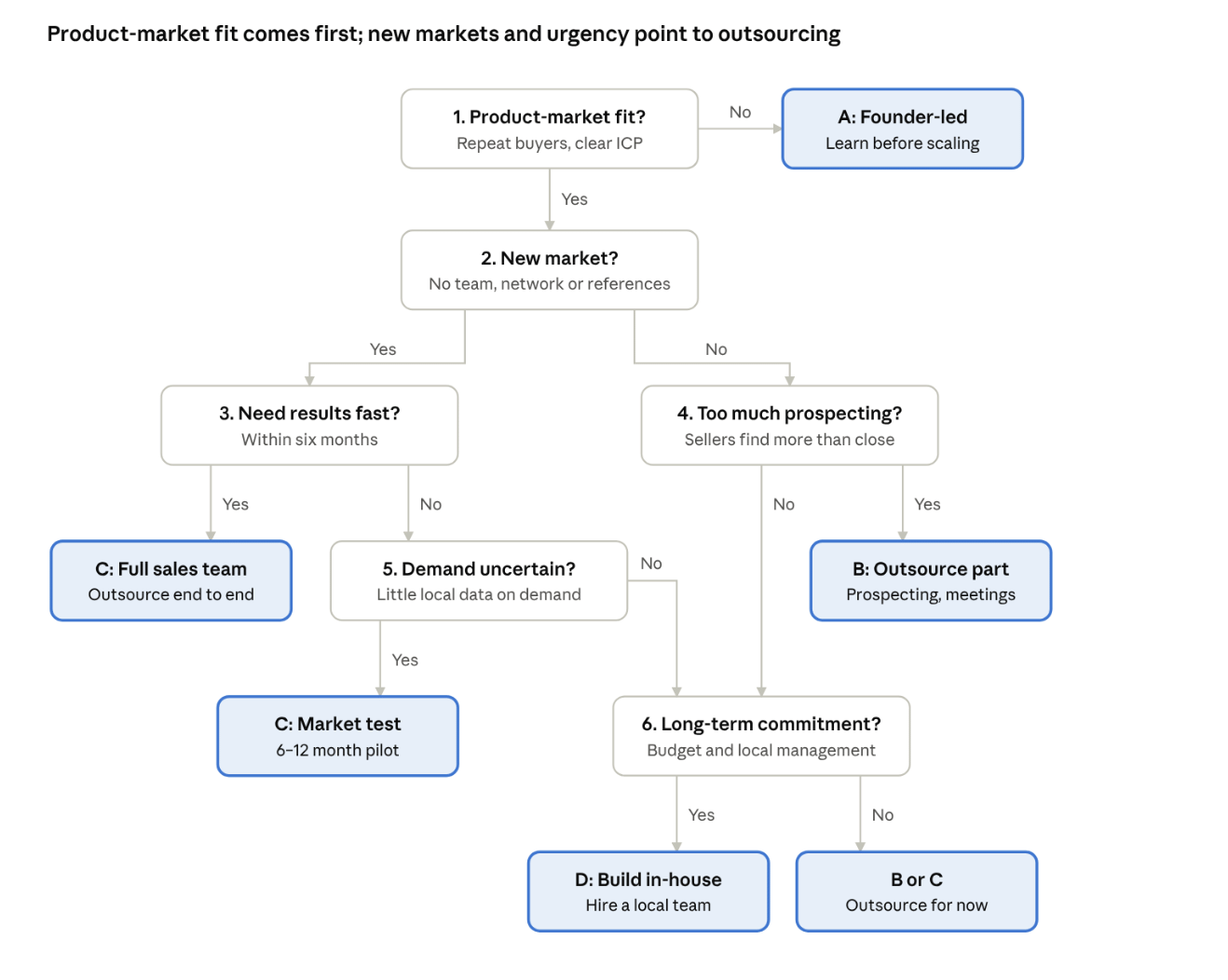
sales outsourcing decision tree · 6 questions, 4 outcomes
Start at question 1 and follow the Yes/No arrows. The full questions and what each outcome means follow below.
Question 1: Do you have product-market fit?
You have paying customers who buy for the same reason, and you can describe your ideal customer in one sentence.
- No → Outcome A: Keep sales founder-led. At most, outsource list building to free up founder time.
- Yes → Go to Question 2.
Question 2: Are you entering a market where you have no sales presence?
A new country, region or vertical where you have no team, network or reference customers.
- Yes → Go to Question 3.
- No → Go to Question 4.
Question 3: Do you need results within the next six months?
Investors, competitors or a budget cycle mean you can't wait for recruitment plus a 3–6 month ramp-up.
- Yes → Outcome C: Outsource a full sales team that acts as your local sales office.
- No → Go to Question 5.
Question 4: Is your internal team spending too much time prospecting?
Your account executives or founders spend more time finding opportunities than closing them.
- Yes → Outcome B: Outsource part of the process, such as prospecting and appointment setting.
- No → Go to Question 6.
Question 5: Is the market potential still uncertain?
You believe in the opportunity, but you lack local data on demand, pricing or competition.
- Yes → Outcome C as a market test: a time-boxed engagement with clear KPIs and a go/no-go moment after 6–12 months.
- No → Go to Question 6.
Question 6: Are you ready to commit to this market long-term?
You expect years of stable demand, you have the budget for permanent hires and you can provide local management.
- Yes → Outcome D: Build in-house.
- No → Outcome B or C. Outsource until revenue justifies permanent headcount.
What each outcome means
Outcome A: Keep sales founder-led
You need customer feedback more than capacity. Run discovery calls yourself, document what works and revisit this tree once your sales story is repeatable.
Outcome B: Outsource part of the process
The most common entry point. An external sales agency or sales development partner handles target lists, multichannel outreach and qualification into meetings; your team closes. It's lower risk, keeps you close to customers and often works as a trial for a broader partnership.
Outcome C: Outsource a full sales team
You outsource the sales team for a market end to end: research, lead generation, meetings, closing and channel partners. It works best when speed and local presence matter and you want to avoid fixed costs before the market is proven. Aexus typically sets up a presence in new markets within about 90 days.
Outcome D: Build in-house
With a proven market and long-term commitment, owning the team usually becomes more cost-effective. Many companies get here after an outsourced phase, keeping its pipeline, reference customers and playbook.
Check the outcome against three practical questions
- Budget: Can you fund a hire's full year-one cost, including recruitment and ramp-up, or does a monthly fee plus performance component suit your cash flow better? See Sales Outsourcing vs. In-House Sales: What Does It Really Cost?
- Ownership: Who internally will own onboarding, feedback and reviews with an outsourced team?
- Exit: How easily can you stop if the market underperforms? Outsourcing contracts typically run 12–18 months with defined termination terms; employment contracts are far less flexible.
Example paths
- Dutch SaaS scale-up entering Germany with a revenue target for next year: Q1 Yes → Q2 Yes → Q3 Yes → Outcome C.
- Industrial tech company whose sales team spends half its time prospecting: Q1 Yes → Q2 No → Q4 Yes → Outcome B.
- Startup with three pilots sold through the founder's network: Q1 No → Outcome A.
Turning the outcome into a plan
The tree tells you which model fits. Next, choose who to work with: 10 Questions to Ask Before Hiring a Sales Outsourcing Company helps you compare providers.
Since 2000, Aexus has supported technology companies across Europe, the Americas and Asia Pacific with every outcome in this tree, from sales development to full-cycle outsourcing and the move to a local team.
FAQ
Everything you need to know
Broadly, yes. A sales agency usually refers to an external company that sells on your behalf. Sales outsourcing describes the model more widely, from appointment setting only to running your entire sales function in a market.
Outsource when you need results within months, when you're entering a market without a local presence or when demand is still uncertain. Hire when the market is proven and you're committed to it long-term.
Yes, and many companies do. Starting with lead generation and appointment setting lets you test a provider's quality before you hand over more of the sales cycle.
Plan for at least 6–9 months in B2B. That gives enough time for onboarding, messaging refinement and building pipeline. Agree measurable KPIs, such as qualified meetings and pipeline value, and a fixed review moment in advance.